etf <- etf_vix[1:55, 1:3]
# Split-------------------------------
h <- 5
etf_eval <- divide_ts(etf, h)
etf_train <- etf_eval$train
etf_test <- etf_eval$test
Bayesian VAR and VHAR
var_bayes() and vhar_bayes() fit BVAR and
BVHAR each with various priors.
-
y: Multivariate time series data. It should be data frame or matrix, which means that every column is numeric. Each column indicates variable, i.e. it sould be wide format. -
porhar: VAR lag, or order of VHAR -
num_chains: Number of chains- If OpenMP is enabled, parallel loop will be run.
-
num_iter: Total number of iterations -
num_burn: Number of burn-in -
thinning: Thinning -
coef_spec: Coefficient prior specification.- Minneosta prior
- BVAR:
set_bvar() - BVHAR:
set_bvhar()andset_weight_bvhar() - Can induce prior on
using
lambda = set_lambda()
- BVAR:
- SSVS prior:
set_ssvs() - Horseshoe prior:
set_horseshoe() - NG prior:
set_ng() - DL prior:
set_dl()
- Minneosta prior
-
contem_spec: Contemporaneous prior specification. -
cov_spec: Covariance prior specification. Useset_ldlt()for homoskedastic model. -
include_mean = TRUE: By default, you include the constant term in the model. -
minnesota = c("no", "short", "longrun"): Minnesota-type shrinkage. -
verbose = FALSE: Progress bar -
num_thread: Number of thread for OpenMP- Used in parallel multi-chain loop
- This option is valid only when OpenMP in user’s machine.
Stochastic Search Variable Selection (SSVS) Prior
(fit_ssvs <- vhar_bayes(etf_train, num_chains = 1, num_iter = 20, coef_spec = set_ssvs(), contem_spec = set_ssvs(), cov_spec = set_ldlt(), include_mean = FALSE, minnesota = "longrun"))
#> Call:
#> vhar_bayes(y = etf_train, num_chains = 1, num_iter = 20, coef_spec = set_ssvs(),
#>     contem_spec = set_ssvs(), cov_spec = set_ldlt(), include_mean = FALSE,
#>     minnesota = "longrun")
#>
#> BVHAR with SSVS prior + SSVS prior
#> Fitted by Gibbs sampling
#> Total number of iteration: 20
#> Number of burn-in: 10
#> ====================================================
#>
#> Parameter Record:
#> # A draws_df: 10 iterations, 1 chains, and 123 variables
#>      phi[1]   phi[2]   phi[3]   phi[4]   phi[5]    phi[6]   phi[7]   phi[8]
#> 1    0.0984   0.2194  -0.2652   0.2980  -0.2345  -0.06799  -0.0155   0.5899
#> 2    0.0926   0.8895  -0.4204  -0.4780  -0.8323   0.00839  -0.3694   1.2569
#> 3    0.1810   0.1385  -0.2097   0.0263  -0.0282   0.04154   0.4615   0.2473
#> 4    0.0483  -0.1452   0.0387   0.6543   0.5076  -0.00704  -0.2087  -0.0455
#> 5    0.1437   0.0748  -0.3827   0.9274   0.2199   0.09925  -0.2772   0.0337
#> 6    0.3688  -0.0228  -0.2136  -0.8470  -0.0906  -0.02568   1.3041   0.3172
#> 7    0.2835   0.1767  -0.1080  -0.1623  -0.3427   0.11703   0.0244   0.6440
#> 8   -0.0147  -0.0287   0.1484  -0.2975   0.0740  -0.05650   0.0920   0.5444
#> 9    0.2213   0.0240  -0.0483  -0.0578   0.2039  -0.00514  -0.0655   0.3481
#> 10   0.1764  -0.0424  -0.0983   0.0310  -0.0352   0.04124   0.1094   0.3814
#> # ... with 115 more variables
#> # ... hidden reserved variables {'.chain', '.iteration', '.draw'}
autoplot() for the fit (bvharsp object)
provides coefficients heatmap. There is type argument, and
the default type = "coef" draws the heatmap.
autoplot(fit_ssvs)
#> Warning: `label` cannot be a <ggplot2::element_blank> object.
#> `label` cannot be a <ggplot2::element_blank> object.
#> `label` cannot be a <ggplot2::element_blank> object.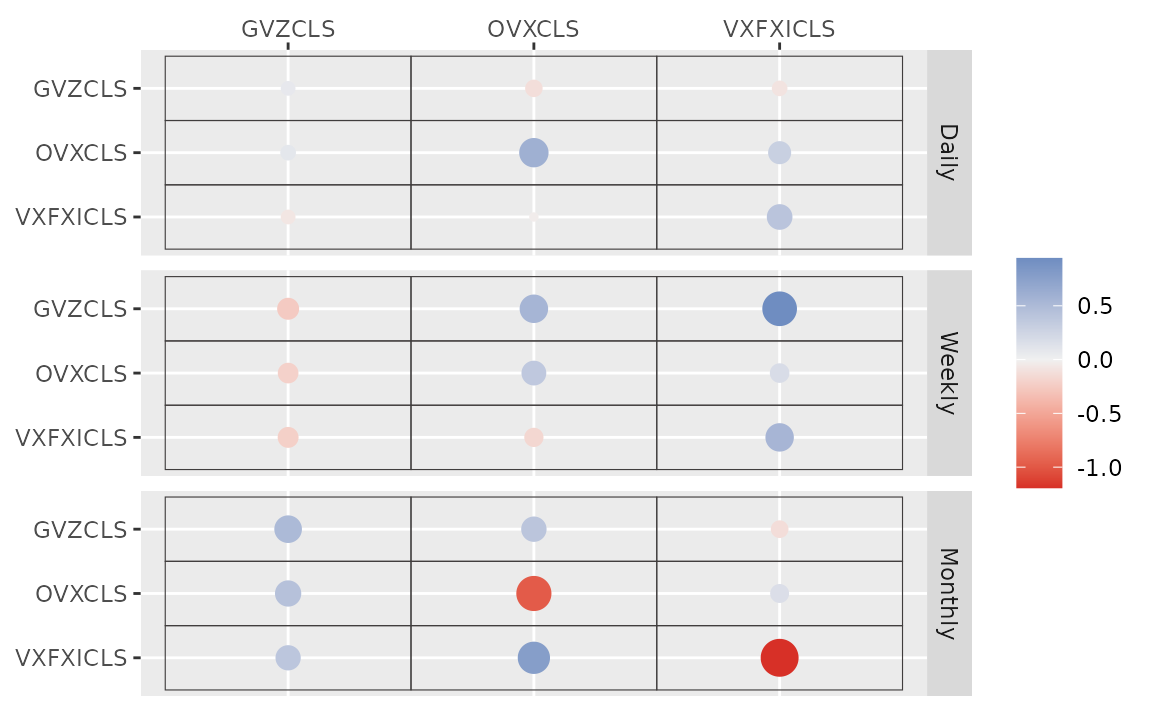
Horseshoe Prior
coef_spec is the initial specification by
set_horseshoe(). Others are the same.
(fit_hs <- vhar_bayes(etf_train, num_chains = 2, num_iter = 20, coef_spec = set_horseshoe(), contem_spec = set_horseshoe(), cov_spec = set_ldlt(), include_mean = FALSE, minnesota = "longrun"))
#> Call:
#> vhar_bayes(y = etf_train, num_chains = 2, num_iter = 20, coef_spec = set_horseshoe(),
#>     contem_spec = set_horseshoe(), cov_spec = set_ldlt(), include_mean = FALSE,
#>     minnesota = "longrun")
#>
#> BVHAR with Horseshoe prior + Horseshoe prior
#> Fitted by Gibbs sampling
#> Number of chains: 2
#> Total number of iteration: 20
#> Number of burn-in: 10
#> ====================================================
#>
#> Parameter Record:
#> # A draws_df: 10 iterations, 2 chains, and 128 variables
#>      phi[1]    phi[2]    phi[3]    phi[4]     phi[5]     phi[6]    phi[7]
#> 1    0.3966   0.06624  -0.04871   0.38894  -0.073796   0.060807  -0.11783
#> 2   -0.0702   0.05350  -0.02313   0.01625   0.102949  -0.083444   0.23774
#> 3    0.0616   0.02422  -0.16276  -0.05549  -0.022509  -0.006240   0.34429
#> 4   -0.0212   0.01121  -0.20882   0.04573  -0.080171  -0.004884   0.28627
#> 5    0.0240  -0.03930  -0.21210   0.00807   0.000561   0.021590   0.19611
#> 6    0.1203   0.02930  -0.00324   0.20999   0.020411  -0.013568   0.00470
#> 7    0.0786   0.00643  -0.06914  -0.14220   0.035252   0.000268   0.02279
#> 8    0.0973   0.01540   0.10813   0.06099  -0.126038   0.007747   0.06279
#> 9    0.1122   0.01931  -0.09498  -0.04683   0.123461  -0.012483  -0.02566
#> 10   0.1360  -0.04451   0.00468   0.01335   0.312362  -0.026677   0.00279
#>     phi[8]
#> 1    0.192
#> 2    0.427
#> 3    0.478
#> 4    0.726
#> 5    0.668
#> 6    0.316
#> 7    0.618
#> 8    0.483
#> 9    0.514
#> 10   0.290
#> # ... with 10 more draws, and 120 more variables
#> # ... hidden reserved variables {'.chain', '.iteration', '.draw'}
autoplot(fit_hs)
#> Warning: `label` cannot be a <ggplot2::element_blank> object.
#> `label` cannot be a <ggplot2::element_blank> object.
#> `label` cannot be a <ggplot2::element_blank> object.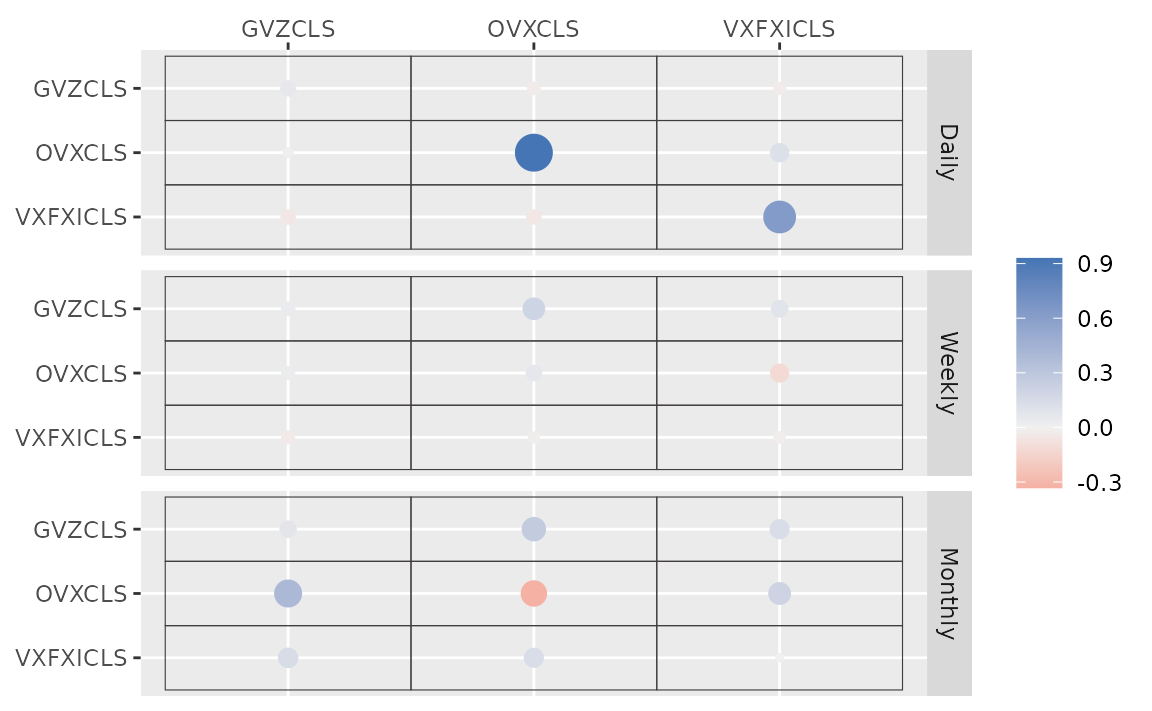
Minnesota Prior
(fit_mn <- vhar_bayes(etf_train, num_chains = 2, num_iter = 20, coef_spec = set_bvhar(lambda = set_lambda()), cov_spec = set_ldlt(), include_mean = FALSE, minnesota = "longrun"))
#> Call:
#> vhar_bayes(y = etf_train, num_chains = 2, num_iter = 20, coef_spec = set_bvhar(lambda = set_lambda()),
#>     cov_spec = set_ldlt(), include_mean = FALSE, minnesota = "longrun")
#>
#> BVHAR with MN_Hierarchical prior + MN_Hierarchical prior
#> Fitted by Gibbs sampling
#> Number of chains: 2
#> Total number of iteration: 20
#> Number of burn-in: 10
#> ====================================================
#>
#> Parameter Record:
#> # A draws_df: 10 iterations, 2 chains, and 63 variables
#>     phi[1]   phi[2]   phi[3]   phi[4]   phi[5]   phi[6]   phi[7]   phi[8]
#> 1   0.4138   0.0619  -0.0515  -0.0866   0.3069  -0.1720  -0.1077  -0.0978
#> 2   0.3537   0.2230  -0.2305   0.3081  -0.0559   0.0545  -0.1199   0.0387
#> 3   0.2705   0.1480  -0.0465   0.1397   0.0360  -0.0918   0.0420   0.1023
#> 4   0.3118   0.4146  -0.1969   0.0566  -0.0404   0.0858   0.0694  -0.0165
#> 5   0.4405  -0.0732   0.0575   0.3073   0.0506  -0.0732   0.0897   0.0475
#> 6   0.0848   0.0288  -0.2301   0.1998   0.1407   0.1085   0.0722   0.2166
#> 7   0.1809   0.0168  -0.0362   0.2371   0.1832  -0.0957   0.1701   0.1061
#> 8   0.1078  -0.1695  -0.2035   0.3734   0.2829   0.0529   0.3574   0.1292
#> 9   0.1737  -0.2284  -0.0848   0.2388   0.3014   0.0252   0.2573   0.2120
#> 10  0.2752  -0.1289  -0.1289   0.2318   0.3415  -0.1629  -0.1696   0.3704
#> # ... with 10 more draws, and 55 more variables
#> # ... hidden reserved variables {'.chain', '.iteration', '.draw'}
Normal-Gamma prior
(fit_ng <- vhar_bayes(etf_train, num_chains = 2, num_iter = 20, coef_spec = set_ng(), cov_spec = set_ldlt(), include_mean = FALSE, minnesota = "longrun"))
#> Call:
#> vhar_bayes(y = etf_train, num_chains = 2, num_iter = 20, coef_spec = set_ng(),
#>     cov_spec = set_ldlt(), include_mean = FALSE, minnesota = "longrun")
#>
#> BVHAR with NG prior + NG prior
#> Fitted by Metropolis-within-Gibbs
#> Number of chains: 2
#> Total number of iteration: 20
#> Number of burn-in: 10
#> ====================================================
#>
#> Parameter Record:
#> # A draws_df: 10 iterations, 2 chains, and 101 variables
#>      phi[1]    phi[2]    phi[3]     phi[4]    phi[5]    phi[6]  phi[7]
#> 1    0.0673  -0.08938   0.03863   0.002067   0.18437  -0.00885   0.528
#> 2    0.0876   0.08196  -0.02062  -0.000971  -0.02574  -0.04645  -0.043
#> 3    0.0900   0.12539  -0.05620   0.007897  -0.04852  -0.06326  -0.150
#> 4    0.0571  -0.15496  -0.12529  -0.005918   0.07125   0.03216  -0.054
#> 5   -0.0333   0.00986  -0.10095   0.000738   0.03849  -0.02630   0.265
#> 6    0.1375  -0.09162  -0.13019  -0.000196   0.12008  -0.12073   0.447
#> 7    0.0553  -0.01401  -0.04965  -0.000145   0.00915  -0.13014   0.371
#> 8    0.1157  -0.05405  -0.00993  -0.007059   0.00462  -0.27838   0.380
#> 9   -0.0154   0.06749  -0.16720   0.005344   0.00302  -0.06744   0.605
#> 10  -0.0373  -0.01340  -0.05551   0.005132   0.00191   0.05309   0.252
#>       phi[8]
#> 1    0.06100
#> 2    0.49112
#> 3    0.17640
#> 4    0.00174
#> 5   -0.04652
#> 6    0.18592
#> 7    0.40027
#> 8    0.40169
#> 9    0.52747
#> 10   0.33785
#> # ... with 10 more draws, and 93 more variables
#> # ... hidden reserved variables {'.chain', '.iteration', '.draw'}
Dirichlet-Laplace prior
(fit_dl <- vhar_bayes(etf_train, num_chains = 2, num_iter = 20, coef_spec = set_dl(), cov_spec = set_ldlt(), include_mean = FALSE, minnesota = "longrun"))
#> Call:
#> vhar_bayes(y = etf_train, num_chains = 2, num_iter = 20, coef_spec = set_dl(),
#>     cov_spec = set_ldlt(), include_mean = FALSE, minnesota = "longrun")
#>
#> BVHAR with DL prior + DL prior
#> Fitted by Gibbs sampling
#> Number of chains: 2
#> Total number of iteration: 20
#> Number of burn-in: 10
#> ====================================================
#>
#> Parameter Record:
#> # A draws_df: 10 iterations, 2 chains, and 95 variables
#>       phi[1]     phi[2]    phi[3]     phi[4]     phi[5]   phi[6]     phi[7]
#> 1   -0.00239   1.68e-04   0.02170   0.422482   0.000518  -0.0159  -0.495052
#> 2   -0.11489  -1.01e-04  -0.09058  -0.161925   0.001962   0.0260   0.288790
#> 3    0.09675  -1.03e-04  -0.05739  -0.072469  -0.007962   0.0362   0.023629
#> 4    0.10078   9.25e-05  -0.04879  -0.023701   0.002286  -0.0387  -0.009170
#> 5   -0.03324  -1.26e-06  -0.03554   0.031459   0.002868  -0.0562   0.020514
#> 6   -0.02685  -3.96e-06   0.00793   0.028456   0.012527  -0.1012   0.008080
#> 7    0.06241  -3.95e-06   0.00953   0.007177   0.020831  -0.0665  -0.001462
#> 8    0.17010   2.26e-06   0.04481   0.001086  -0.054743   0.0309  -0.000354
#> 9    0.02462  -4.46e-07  -0.07490  -0.002261   0.088378   0.0111   0.000552
#> 10   0.05811  -2.73e-06  -0.04678   0.000935  -0.030620  -0.0113  -0.000847
#>     phi[8]
#> 1    0.422
#> 2    0.499
#> 3    0.466
#> 4    0.689
#> 5    0.679
#> 6    0.305
#> 7    0.445
#> 8   -0.211
#> 9    0.533
#> 10   0.648
#> # ... with 10 more draws, and 87 more variables
#> # ... hidden reserved variables {'.chain', '.iteration', '.draw'}
Bayesian visualization
autoplot() also provides Bayesian visualization.
type = "trace" gives MCMC trace plot.
autoplot(fit_hs, type = "trace", regex_pars = "tau")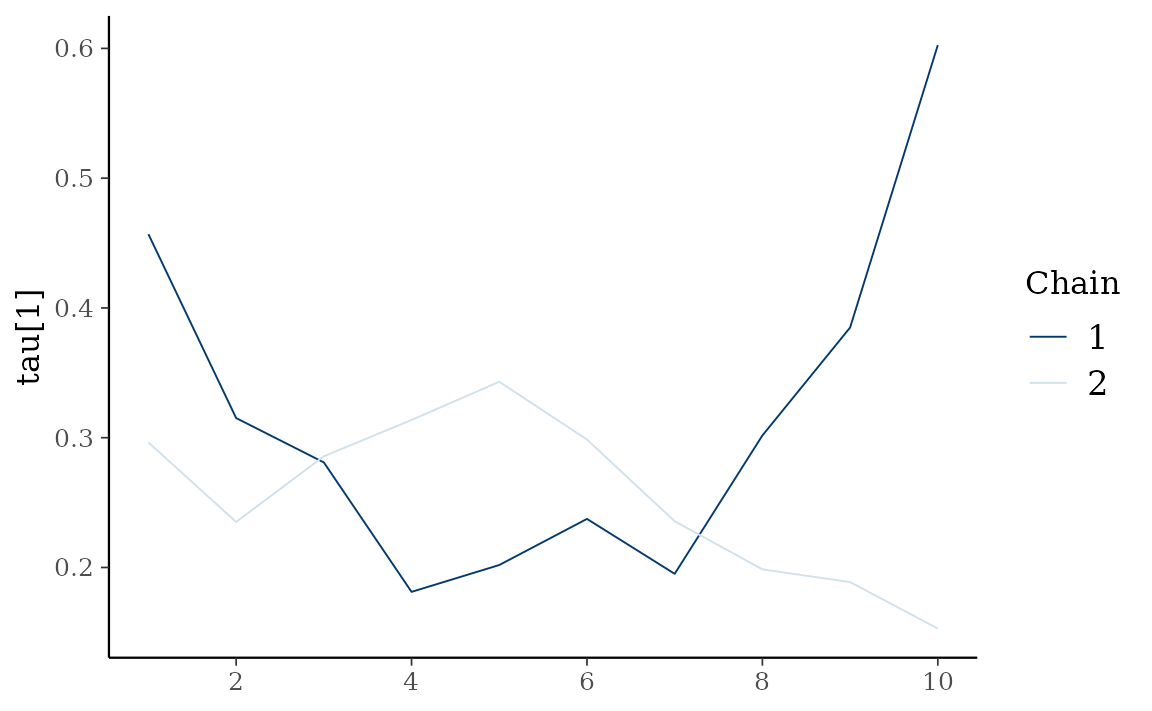
type = "dens" draws MCMC density plot. If specifying
additional argument facet_args = list(dir = "v") of
bayesplot, you can see plot as the same format with
coefficient matrix.
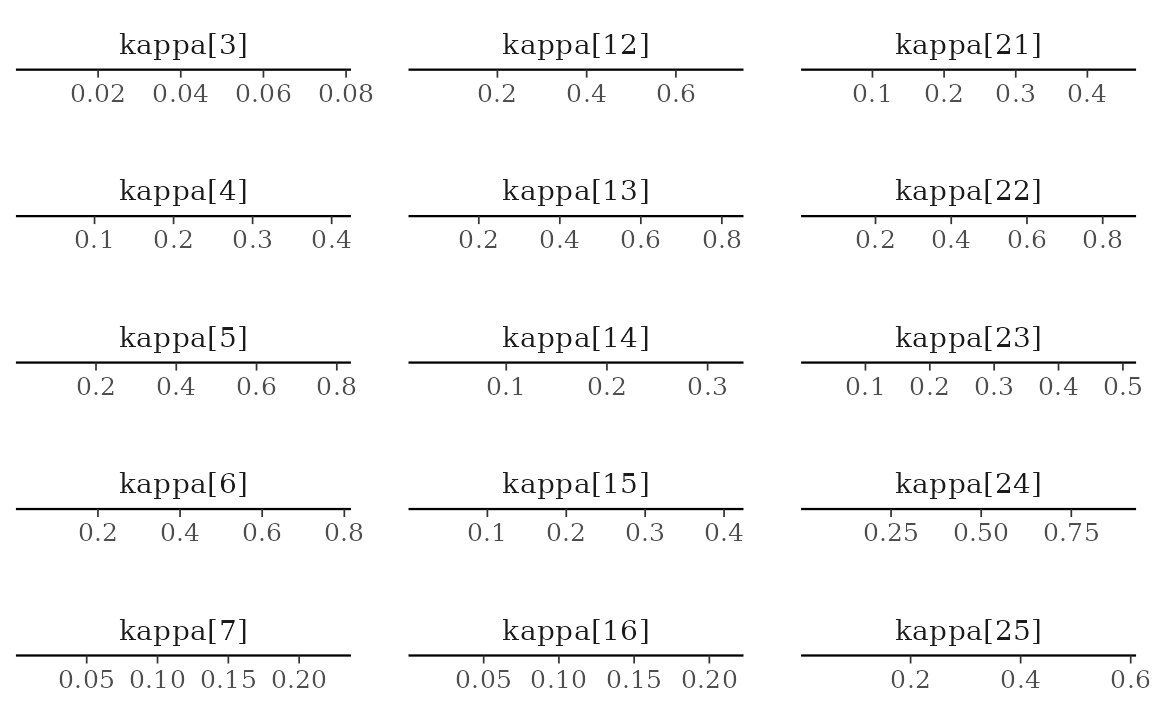
autoplot(fit_hs, type = "dens", regex_pars = "kappa", facet_args = list(dir = "v", nrow = nrow(fit_hs$coefficients)))